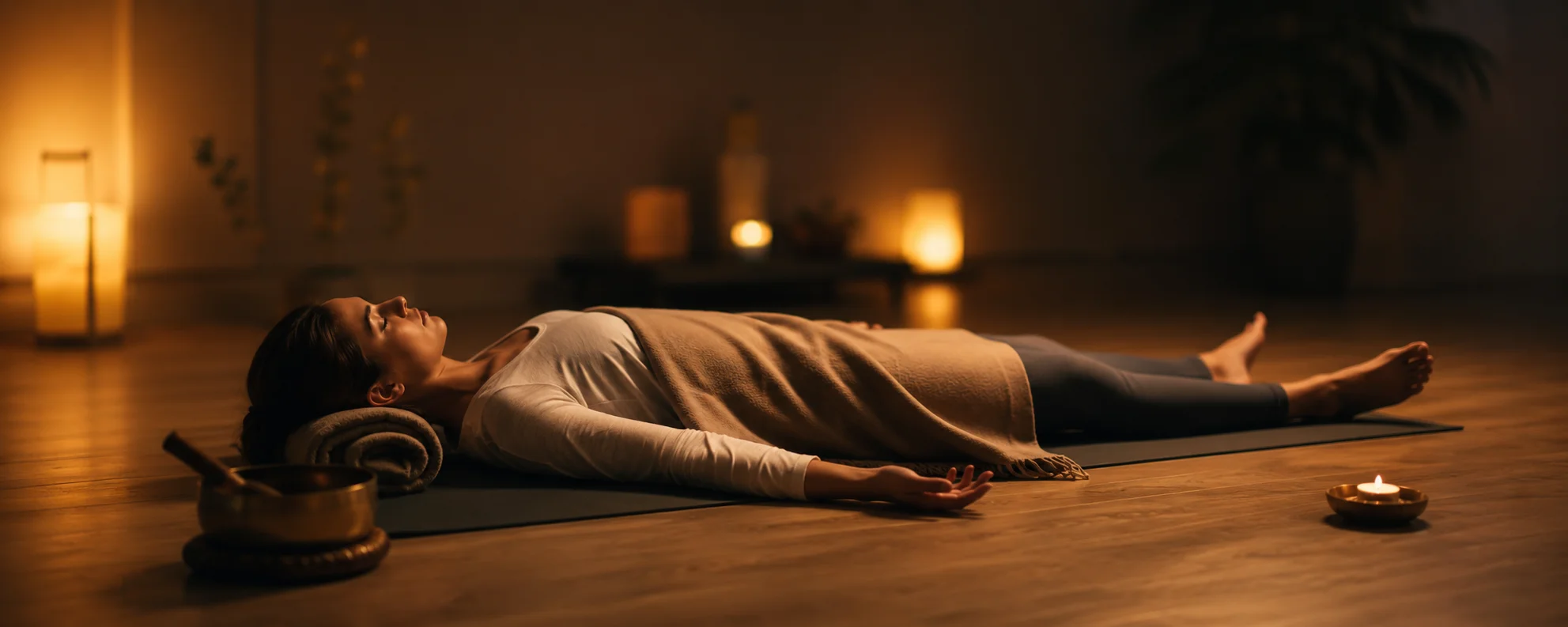
What Is Yoga Nidra?
Yoga Nidra, often translated as "yogic sleep," is a guided meditation practice that leads you into a state poised between waking and sleeping. Unlike ordinary rest, where the mind drifts away entirely, Yoga Nidra keeps a thread of awareness alive even as the body settles into profound stillness. Practitioners often describe it as sleeping with the body while the mind stays gently awake.
It is not sleep in the conventional sense, and it is not meditation in the seated, effortful sense either. It occupies a middle space — one that traditional yogic texts describe as deeply restorative precisely because it lets the nervous system rest without the mind needing to "do" anything at all.
Where It Comes From
Yoga Nidra has roots in the tantric tradition, where structured relaxation and internalized awareness were used as a doorway into deeper states of consciousness. In the twentieth century, the practice was systematized and popularized in a form accessible to modern practitioners — lying down, following a voice, moving attention through the body — without requiring years of prior training.
What makes it valuable today isn't its antiquity alone, but how directly it addresses a very modern problem: nervous systems that rarely get the chance to fully switch off.
What Happens in the Body
During Yoga Nidra, the body moves toward a state associated with deep relaxation — heart rate slows, breathing lengthens, and muscular tension releases. Practitioners are guided through techniques such as rotating attention through different parts of the body, becoming aware of the breath, and holding gentle intention (sankalpa) — all while remaining lying down, eyes closed, with no physical movement required.
Because the practice asks so little effort from the body, it's accessible in a way many other practices aren't — no flexibility, stamina, or prior experience needed. All that's asked is to lie down and listen.
Why It Matters for Rest and Stress
Modern life keeps the nervous system in a near-constant state of low-grade alertness — notifications, deadlines, decisions, noise. Even a full night's sleep doesn't always undo that. Yoga Nidra offers something different: a deliberate, guided descent into stillness that gives the nervous system explicit permission to stand down.
Regular practitioners often report:
- Falling asleep more easily afterward, or feeling refreshed after even a short session
- A noticeable drop in background anxiety and mental noise
- Improved ability to concentrate once the session ends
- A gentler, more spacious relationship with difficult emotions, simply from having practiced sitting with stillness
An Ayurvedic Lens
From an Ayurvedic perspective, much of modern stress reflects an aggravated vata — the quality of movement, air, and instability. Yoga Nidra works directly against this: it is slow, grounding, and still, offering the nervous system a counterweight to the scattered, overstimulated state that vata imbalance produces.
It also touches ojas — the subtle reserve of vitality and resilience that Ayurveda considers foundational to health. Deep, conscious rest is one of the few things that genuinely replenishes ojas, rather than simply distracting from its depletion.
A Simple Way to Begin
You don't need a teacher present to start experiencing the basics:
- Lie down somewhere quiet, comfortable, and warm. Let your arms rest slightly away from your body, palms facing up.
- Close your eyes. Take a few slow breaths, letting each exhale be longer than the inhale.
- Silently and slowly, bring your attention to each part of your body in turn — right hand, right arm, right shoulder, and so on — without trying to relax anything, just noticing.
- If your mind wanders, that's expected. Simply return to noticing the body.
- Stay in this state for 10–20 minutes, then slowly bring gentle movement back into your fingers and toes before opening your eyes.
For a fuller experience, a guided audio recording — where a teacher's voice walks you through the body and breath — is usually far more effective than attempting it alone from memory, especially at first.
A Gentle Note
Yoga Nidra is generally considered safe for most people, but if you are managing a diagnosed mental health condition, are pregnant, or have any concerns, it's worth checking with a qualified practitioner or your healthcare provider before beginning a regular practice — as with any new wellness routine.
Closing Thought
In a culture that often equates rest with laziness, Yoga Nidra offers a quiet rebellion: the idea that conscious, deliberate stillness is not an absence of effort, but a discipline in its own right — one that modern nervous systems, stretched thin by constant motion, may need more than almost anything else.